About
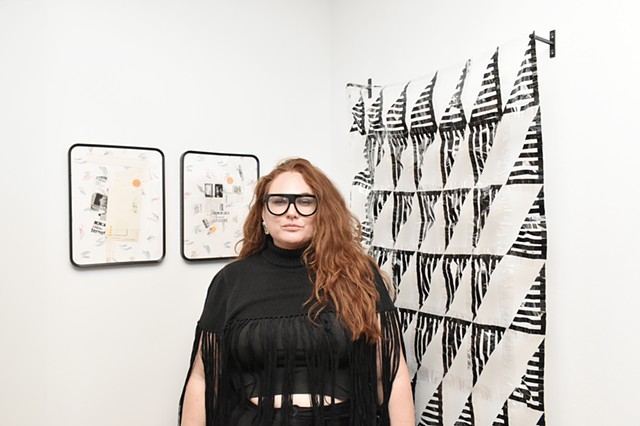
Rebecca Griffith is an interdisciplinary artist, educator, and manager of Purple Window Gallery. Her curatorial practice centers on community outreach and public initiatives that democratize the art world and foster belonging. She spearheaded Hello USPS, a mail art initiative that connected over sixty participants across the United States during the 2020 lockdown. Her curatorial approach is generative, facilitating co-creation and interaction among participants. She has curated exhibitions at Purple Window Gallery, Northern Illinois University, Dream Clinic Project Space, and Unpacked Mobile Gallery.
Griffith has exhibited at the University of Oople (Poland), Ukrainian Institute of Modern Art, Women Made Gallery, Heaven Gallery, Terrain Exhibitions, and Ann Arbor Art Center, among other Midwest galleries and cultural institutions. She received first place in the emerging artist exhibition at Cleve Carney Art Gallery in 2018 and served as curator for Northern Illinois University's President's Office that same year. She earned her B.S.Ed. in 2013 and M.F.A. in 2018 from Northern Illinois University. She currently works in community outreach and engagement at the University of Illinois.
Rebecca Griffith’s work examines the process of caregiving for a parent’s chronic disease and coping with this from a young age to adulthood. By excavating selected VHS cassettes and imagery from movies, Griffith recalls a time in her life when her mother was not diagnosed with multiple sclerosis and was independently running a video store in the early 1990s. Griffith uses the VHS to address how we process information, and memory by creating delicate quilts, collages, and installations from films of her childhood.
Griffith’s practice also considers the domestic spaces, rituals, and cultural influences that shape our understanding of care, identity, and relationships. Drawing from personal archives, popular media, and familiar household objects, she explores how memories become embedded in everyday environments and how they shift through the passage of time. Her work often compares nostalgia with the more complicated realities of caregiving, particularly the tension between tenderness, obligation, rest, and productivity. Through repurposed materials and layered installations, Griffith examines the ways we preserve, reinterpret, and sometimes reclaim the images and experiences that inform our relationships with ourselves and others.